
1. Introduction: The Unseen Red Lines
In the high-gloss corridors of global trade and the hallowed halls of Western academia, there is a comforting fiction that freedom of thought remains a protected border. However, for those of us investigating the mechanics of modern authoritarianism, the reality is far grimmer. Beneath the surface of perceived liberty lies a sophisticated web of “invisible” restrictions. Today’s censorship is not merely about the heavy-handed deletion of content; it is a refined strategy of distraction and psychological maneuvering. The most effective red line is the one the target draws for themselves. For the modern scholar, journalist, or corporate executive, the existential question is no longer “Will I be censored?” but rather “At what point did I start censoring myself to maintain access?”
2. The “Little Distraction”: Why the “Three T’s” are a Shell Game
To suppress discourse that fundamentally challenges its legitimacy, the Chinese Communist Party (CCP) employs a tactic described by analyst Isaac Stone Fish as the “Little Distraction.” This strategy utilizes public outrage and private penalties to make specific topics—the “Three T’s” (Taiwan, Tibet, and Tiananmen)—appear so “radioactive” that they consume all available oxygen in the room.While the world fixates on these three issues, the Party secures a tactical victory: the distraction obscures deeper, more sensitive questions regarding the Party’s right to rule or the conduct of its top leadership. This is not just an academic concern; it is a corporate survival manual. As Stone Fish notes:”China has a long and very consistent track record of trading the real or imagined benefits of ‘access’—visas, market share, joint venture approvals, research cooperation… for acquiescence and/or silence on its ‘red line’ issues.”The effectiveness of this shell game is evident in the groveling apologies of global brands. In 2018, Mercedes-Benz issued a frantic apology after merely quoting the Dalai Lama on Instagram. Marriott was forced to shut down its Chinese apps for a week after an employee “liked” a post regarding Tibetan nationhood. Perhaps most telling was the 2018 demand by the Civil Aviation Administration of China that 44 foreign airlines reclassify Taiwan as part of China; despite the U.S. calling the move “Orwellian nonsense,” most major carriers, including United, American, and Delta, eventually bowed to the pressure. By focusing the world’s ire on these “peripheral” sensitivities, the Party ensures that the “Little Distraction” prevents any serious investigation into the “Red Line” issues that actually matter: leadership corruption and regime change.
3. The “Anaconda in the Chandelier”: Self-Censorship in Elite Universities
Academic self-censorship functions through the metaphor of the “anaconda in the chandelier,” a term famously coined by scholar Perry Link. The snake need not strike to be effective; its silent, looming presence forces everyone in the room to “naturally” adjust their behavior. In Western universities, this pervasive silence is driven by a triad of pressures: financial dependence on over 350,000 Chinese students, the threat of visa denials for researchers, and the active monitoring of students on foreign soil by the Ministry of State Security.This has birthed a culture of “politeness”—a euphemism for silence. As Georgetown’s Jim Millward notes, scholars often frame self-censorship as “translating for a particular audience” or being a “polite guest.” This “politeness” is most acute at institutions maintaining satellite campuses in China, which effectively serve as “hostages” to Beijing’s whims. These institutions include:
- Stanford (Center at Peking University)
- Harvard (Harvard Beijing Academy)
- Columbia (Global Center in Beijing)
- New York University (NYU Shanghai)
- Johns Hopkins (Nanjing)These campuses remain vulnerable to what Professor Minxin Pei calls “misery” tactics: the ramping up of sudden health and safety inspections, the denial of visas for visiting faculty, or the looming threat of administrative closure if a university hosts a high-profile dissident in the U.S.
4. Trapped at the Border: The Quiet Explosion of Exit Bans
A terrifying tool of coercion is the “Exit Ban,” which turns the Chinese border into a one-way valve. Drawing from legal analyst Lili Song’s research, we see a system of “unlawful” leverage where individuals—often with no criminal charges—are used as pawns in international disputes. US citizens like Daniel Hsu (trapped for four years) and the Liu siblings (trapped for three) were held not for their own alleged crimes, but to pressure relatives abroad to return.The legal machinery of these bans is intentionally opaque, often leaving targets unaware of their status until they are stopped at the airport gate.| Mechanism | Targeted Group | Primary Legal Basis || —— | —— | —— || Passport Access Restrictions | PRC Citizens | Passport Law Articles 13, 14, 15 (Refusal to issue or seizure for “national security” or pending cases) || Prohibition of Exit | PRC & Foreigners | Exit-Entry Law Articles 12 & 28 (Broad grounds including “unsettled civil cases” or being a “suspect”) || Criminalization of Departure | PRC Citizens | PRC Criminal Law Article 322 (Punishing “clandestine” or unauthorized exit with up to 3 years’ imprisonment) |
The reach of Article 322 is global; it was used to extradite and convict political dissident Jiang Yefei after he fled to Thailand. This opacity creates a landscape where the law is not a set of rules, but a weapon of convenience.
5. Digital Long Arms: Intimidation Beyond the Border
Authoritarian reach no longer stops at the shoreline. Through “digital transnational repression,” the state monitors the diaspora with clinical precision. Marcus Michaelsen of the Citizen Lab testifies that technology has turned global connectivity into an instrument of control. The methods are relentless: agents use Open-Source Intelligence (OSINT) to map social relations, deploy Pegasus spyware to infiltrate phones, and leverage Proximal Threats —threatening calls made to exiles by their own family members back home via WhatsApp.The psychological fallout is a state of “mental stress, paranoia, and social isolation.” Perhaps most tragically, Michaelsen notes that in many liberal democracies, diaspora members are viewed as “vectors for interference” rather than vulnerable communities in need of protection. This digital siege drives many to withdraw from activism entirely. As the digital space becomes a minefield, many in the diaspora have sought refuge in physical hubs of culture—only to find those final sanctuaries are also being dismantled.
6. The Fading “Red Line”: The Death of the Independent Bookstore
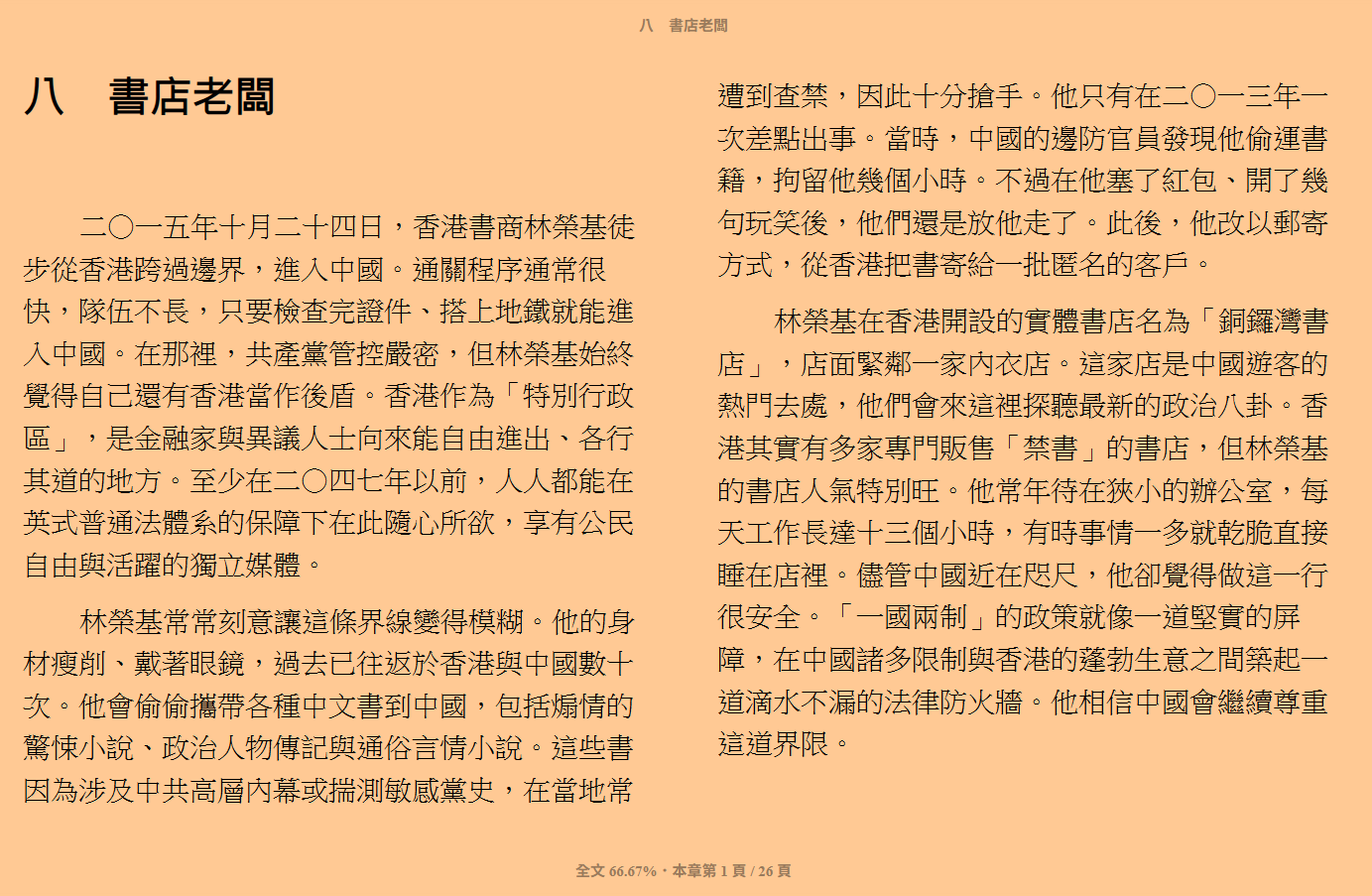
The physical manifestation of this narrowing discourse reached a breaking point on July 15, 2026 . In a coordinated strike, Hong Kong authorities raided the independent bookstores “Have A Nice Stay” —founded by former journalists—and “Greenfield Book Store.” Five people were arrested under the 2024 National Security Law (Article 23) for selling “seditious” material.The justification offered by Security Chief Chris Tang was chilling in its simplicity. Comparing booksellers to food vendors, Tang stated: “Just as a vendor cannot sell poison… a bookseller has a responsibility to ensure their stock does not contain poison or breach the law.” This “poison” is never explicitly defined, creating what the owners of “Have A Nice Stay” called an “elusive red line” that makes business—and thought—impossible.As analyzed by Emily Feng in Let Only Red Flowers Bloom , these raids are the endgame of a “high-pressure assimilation.” While the world is distracted by the “Three T’s,” the Party is quietly erasing all local “blooms”—from Hong Kong’s independent spirit to Uyghur and Tibetan identity—in favor of a singular, Han-centric, Mandarin-speaking national identity. The goal is to smooth over all internal differences until only “Red Flowers” remain.
7. Conclusion: The Future of the Global “Red Line”
The disparate threads of academic silence, exit bans, digital surveillance, and the crushing of independent literature are not isolated incidents; they are the weave of a global regime of assimilation. The “Red Line” is no longer a static border in the South China Sea; it is a mobile, invisible boundary being enforced in the classrooms of Cambridge and the boardrooms of New York.The most profound discussions of this fear often happen in the shadows. On Chinapol , a private, members-only listserv for China experts, an economist recently captured the dilemma facing the international community:“The art is learning to judge when you’re censoring yourself out of fear… If you put any worth on your own values, sometimes you have to be willing to accept the cost of upholding them.”As China’s global influence expands, we are all being asked to name our price. At what point does the benefit of access to a $11 trillion economy finally lose its value against the total erosion of our own integrity? The red line is moving. The question is whether we will even notice when it crosses us.