

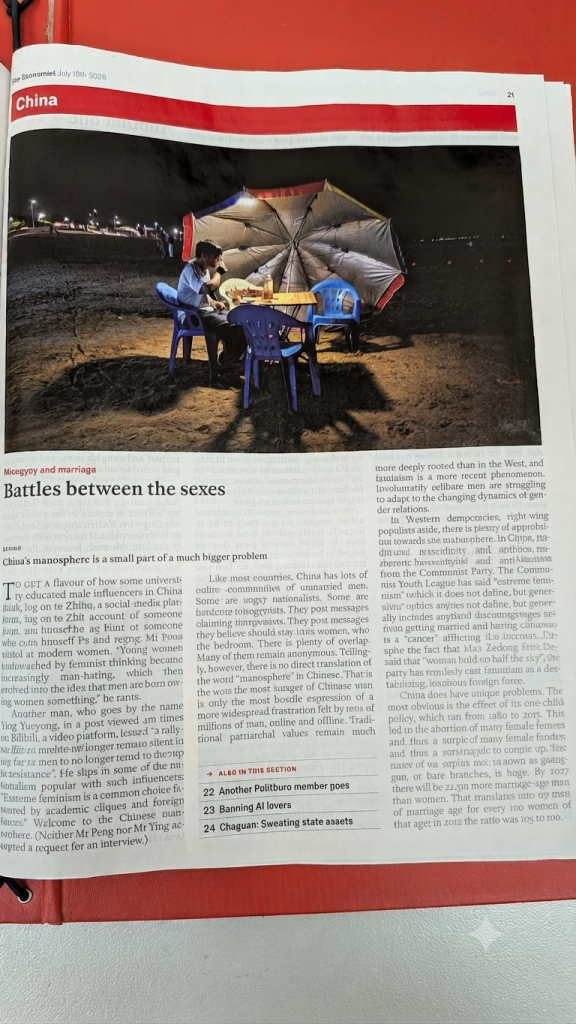
**China is tightening control over AI romantic companions and grappling with a deep gender/marriage crisis rooted in demographics and traditional values, while showing both parallels and sharper differences with the West.**### Key points from the articles (The Economist, 18 July 2026)**AI companions (“No more bots”)** China has introduced national rules (effective mid-July) aimed at reducing “emotional dependence” on AI. Virtual companion services are banned for minors; companies must stop users from becoming infatuated or harming real-life relationships, prohibit pornography, regularly remind users they are talking to AI (not a human), and encourage breaks. Popular apps (ByteDance’s Doubao, MiniMax’s Talkie/Maoxiang/Catbox, etc.) had been heavily used for long emotional conversations, virtual dates, and even mimicking deceased friends. Tech firms had been making significant revenue from these “sticky” relationships. Regulators cite risks of addiction, self-harm, and further damage to already-low fertility and marriage rates. **Comparison with foreign practice**: Several American states have passed laws targeting AI services that sustain emotional relationships and allow civil lawsuits. China’s rules are more comprehensive and national in scope, explicitly linking the ban to demographic and social-stability goals. Chinese firms can still sell more unrestricted AI companions to foreign users (some already have far more overseas users than domestic ones). China’s non-AI “maiden” romance games remain a booming export.**Gender relations and marriage (“Battles between the sexes”)** China’s online “manosphere” (angry, often misogynistic unmarried men) is framed as one expression of a much larger problem: a large surplus of men created by the one-child policy, persistent traditional patriarchal expectations, high bride prices, housing costs, and rising female education/ambitions. By 2027 there are projected to be roughly 22.5 million more marriage-age men than women. Rural men and lower-income urban men struggle particularly hard; matchmakers report extreme imbalances. Online discourse includes hardcore misogyny, complaints about “extreme feminism,” and pressure on men to provide flats and large bride prices. The state promotes traditional marriage and child-rearing, has banned “sissy men” from television, and censors content seen as encouraging singledom or gender antagonism, while also criticising some expressions of male anger. **Comparison with the West**: Western countries also have manosphere communities, right-wing populist rhetoric defending traditional masculinity, and declining marriage/fertility. In China the phenomenon is described as more deeply rooted in traditional culture, amplified by the demographic distortion of the one-child policy, and operating under tighter state control (Communist Party support for traditional gender roles mixed with censorship of both “extreme feminism” and unconstrained male resentment). Female educational gains are stronger relative to men than in earlier decades, yet social expectations on men as providers remain heavier.**Political context** The same issue also covers continued high-level purges under Xi Jinping (another Politburo member removed amid corruption allegations), illustrating the leadership’s broader emphasis on discipline and social stability.### Conclusion: China vs foreignChina faces a more acute, state-managed version of problems that also exist in the West—declining marriage and fertility, online gender antagonism, and the emotional pull of AI companions. The demographic imbalance (surplus men) is a distinctive Chinese legacy of the one-child policy and is far larger than typical Western sex-ratio issues. Traditional patriarchal expectations remain stronger, producing sharper tensions as women’s education and autonomy rise. The Chinese state’s response is characteristically top-down and instrumental: it restricts AI romance to protect fertility and social stability, promotes conventional family norms, and tightly polices online gender discourse. Western responses are more fragmented (state-level laws, civil litigation, cultural debate) and less explicitly tied to demographic engineering. Chinese firms, meanwhile, continue to export both AI companions and romance games that face fewer restrictions abroad. In short, the underlying social frictions are recognisably modern and cross-cultural, but China’s scale of demographic distortion, residual traditionalism, and capacity for national regulatory intervention make its version both more severe and more deliberately managed than the typical foreign (especially Western) experience.