
source #scmp
China’s semiconductor industry has made notable strides in dynamic random-access memory (DRAM), the core technology behind RAM used in computers, smartphones, and servers. Led primarily by ChangXin Memory Technologies (CXMT), Chinese producers have expanded capacity rapidly and captured a growing slice of the market through competitive pricing and reliable domestic supply. However, claims of overall domination remain overstated.
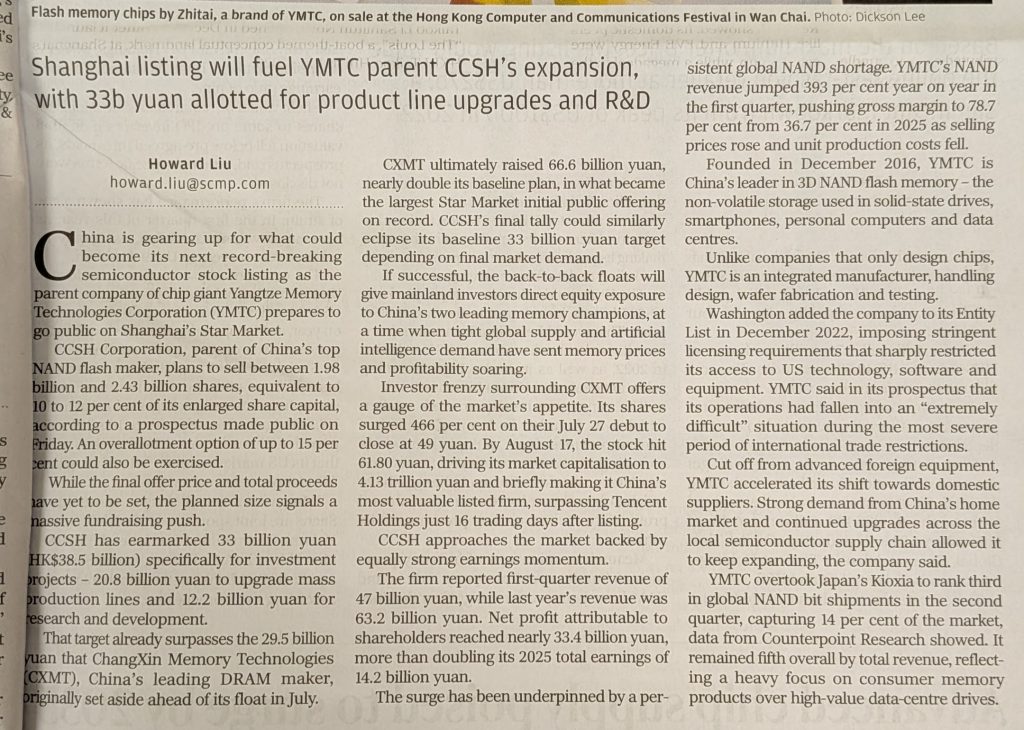
As of mid-2026, CXMT holds approximately 7–8% of the global DRAM market by revenue, ranking fourth worldwide. This marks a sharp rise from roughly 3–4% a year earlier, making it the fastest-growing supplier. Samsung leads with about 38–39%, followed by SK Hynix (26–29%) and Micron (22–25%). The traditional “Big Three” still control nearly 90% of the market. CXMT’s strength lies more in conventional DRAM (DDR4/DDR5 and LPDDR) for consumer and mid-range applications than in high-bandwidth memory (HBM) for advanced AI, where it lags.
Chinese chips have historically been priced lower—often 5–15% below global averages—helping them gain traction in cost-sensitive segments and China’s domestic market. Stable supply has been a key advantage amid global shortages driven by AI demand, with CXMT ramping wafer capacity aggressively. Projections suggest it could cover around half of China’s own DRAM demand by 2028, though it remains fully booked and cannot fully meet even domestic needs in the near term.
On X (formerly Twitter), observers note both the progress and limits. One post highlighted CXMT’s rapid growth to 7.7% share and the potential for cheaper Chinese memory to pressure prices, while another cited Goldman Sachs research projecting CXMT could dominate 50% of China’s domestic DRAM market by 2028. Others pointed out that global leaders still hold the vast majority of share and that capacity constraints persist.
In summary, China has established a solid and expanding foothold with low-to-competitive prices and improving supply reliability, particularly at home. Yet global dominance remains distant; the industry continues to be led by South Korean and U.S. giants, with CXMT serving as an emerging fourth player rather than a market ruler.