
source #SCMP
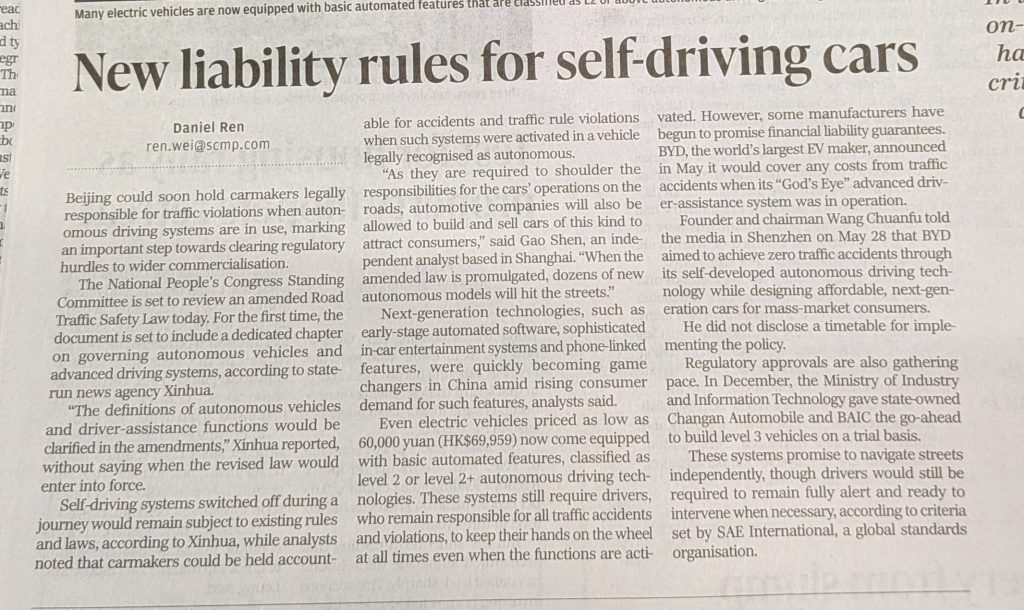
Mainland China’s draft amendments to the Road Traffic Safety Law would hold manufacturers or importers responsible for traffic violations when an autonomous driving function is activated. Hong Kong should adapt this principle carefully rather than copy it wholesale, given its distinct legal system, road environment and existing AV framework under the Road Traffic Ordinance and Cap. 374AA.
Hong Kong’s streets pose special difficulties. Many roads are narrow, winding and tightly packed with buses, trams, pedestrians and sudden lane changes. High-rises block satellite signals and create reflections; roundabouts and mixed traffic add complexity that wide mainland test routes do not fully capture. Systems trained elsewhere can misread local conditions. Liability rules must therefore rest on proven performance in these constrained settings, not merely on activation of a labelled “autonomous” mode. Safety-first testing with backup operators, already required in current pilots, should remain the baseline until data show consistent reliability.
Insurance arrangements need equal attention. Cap. 272 already requires third-party cover for any vehicle on the road, including trial AVs. As operations move toward commercial use and higher automation, the existing Working Group should define who pays when the system—not a human—is in control: the registered owner, the operator, the manufacturer, or a dedicated AV product. Clear policy wording and data-sharing will reduce disputes and keep premiums viable. Without this, commercial rollout will stall.
The core question is belonging of responsibility. When the autonomous function is off, the human driver stays liable under ordinary rules. When it is on and the vehicle is legally recognised as autonomous, responsibility should shift toward the party that designed, certified and maintains the system—typically the manufacturer or authorised operator—while preserving a residual duty on the remote or onboard supervisor. Hong Kong can adopt this split without abandoning common-law principles of negligence and product liability. Defining “activation” precisely, requiring event data recorders, and aligning with GB and SAE levels already referenced in local law would give courts and insurers workable tests.
Applied this way, the mainland approach can accelerate safe commercialisation in HKSAR while respecting local streets, insurance markets and legal traditions. Clarity on these three points will let innovation proceed without leaving victims or operators in legal limbo.