
Summary of the article
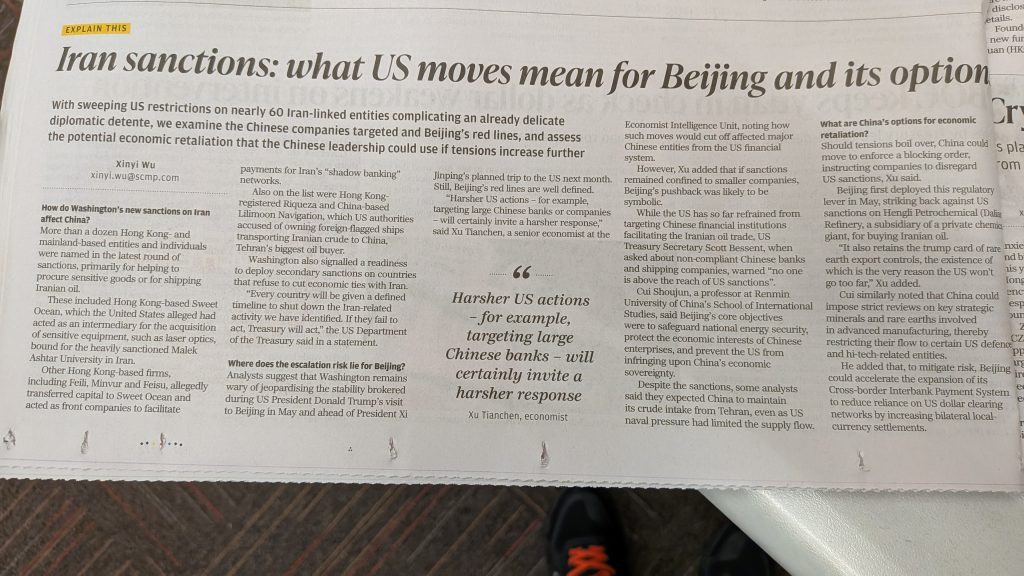
The #SCMP piece (Xinyi Wu, late August 2026) covers a new U.S. sanctions package of nearly 60 Iran-linked entities and individuals. Washington framed it as cutting remaining economic lifelines (oil revenue, technology procurement, shipping, some cyber and financial channels). Several of the named parties are Hong Kong- and mainland China-based.
Targeted Chinese-linked names include:
- Hong Kong firms such as Sweet Ocean Industrial and related companies (Feili, Minvur, Feisu and others), accused of acting as intermediaries or fronts for procuring sensitive goods, including laser optics bound for Malek Ashtar University of Technology in Iran (a defense-linked institution long associated with missile and dual-use work).
- Shipping-related names such as Riqueza and Lilimoon Navigation, accused of owning or operating vessels that moved Iranian crude to China, Iran’s largest oil customer.
The U.S. also signaled it could apply secondary sanctions on countries that do not cut Iran-related activity, with a stated timeline. Treasury Secretary Scott Bessent’s public line was that no one is beyond the reach of U.S. sanctions, while the package itself still avoided the largest Chinese banks. Analysts quoted in the article (Xu Tianchen of EIU; Cui Shoujun of Renmin University) treat the current list as more symbolic if it stays limited to smaller firms. Hitting major Chinese banks or core energy/financial channels would, in their view, cross Beijing’s red lines and produce a sharper response.
Possible Chinese counters discussed: a blocking order telling firms to ignore U.S. measures; rare-earth and strategic-mineral restrictions aimed at U.S. defense and high-tech supply chains; faster use of CIPS and bilateral local-currency settlement to reduce dollar-clearing exposure. Beijing’s stated priorities in the piece are energy security, protecting Chinese commercial interests, and sovereignty. China has already used a blocking-style response against earlier U.S. measures on a Dalian petrochemical subsidiary. Despite the new designations, several analysts still expected China to keep buying Iranian crude, even with naval pressure reducing volumes.
Judgment on human rights and centralized power
Iran is a clear case of a highly centralized, theocratic system: ultimate authority sits with the Supreme Leader and associated security organs, not with competitive elections or independent courts. Political opposition, protest, women’s dress and movement, religious minorities, and due process are tightly controlled. That record is long-standing and well documented; it is not a side issue. The same centralized structure makes it easier for the state to run sanctioned procurement and oil-evasion networks with limited domestic check.
China is a different ideology and scale, but it is also a centralized one-party system. Power is concentrated in the Party leadership; organized political opposition is not permitted; speech, assembly, and several minority and territorial issues are treated as security matters. The pattern the user points to is real: both are “central power” governments in the sense that the center does not accept independent political contestation or a strong rights-based constraint on the state.
The U.S. measures in this article are aimed at Iran’s remaining revenue and military-related supply chains, not at writing a human-rights report. Closed political systems and weapons/sanctions-evasion activity often travel together because there is less internal accountability. That does not make every Chinese trading firm a moral actor, and it does not make U.S. secondary sanctions automatically wise or cost-free. It does mean the “undeveloped human rights / same central-power government” observation is a fair description of the Iranian system and a recognizable family resemblance with other highly centralized states. The article itself stays in the narrower lane of oil, banks, red lines, and retaliation options.