
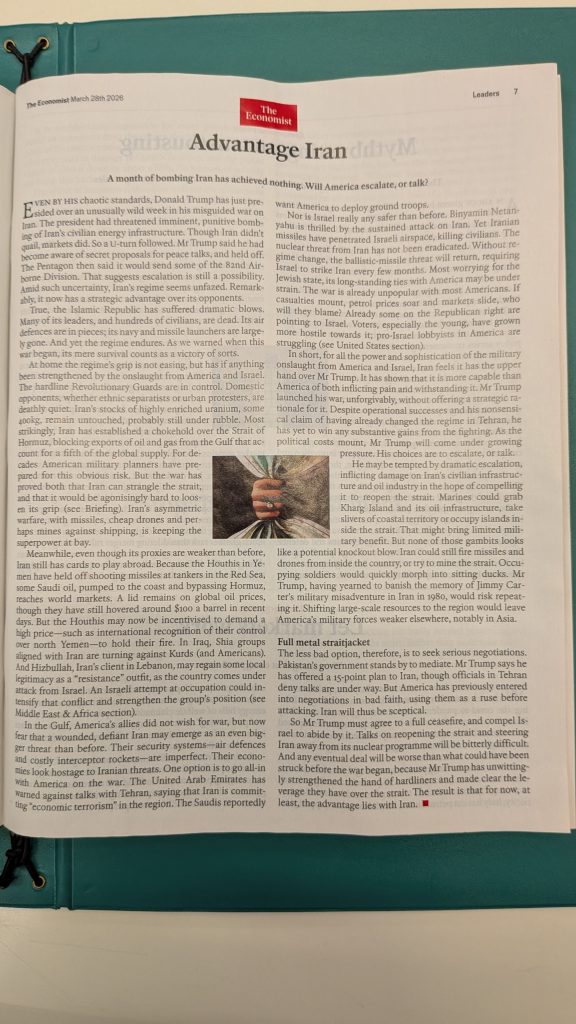
The provided article from The Economist (dated March 28, 2026) titled “Advantage Iran” analyzes the geopolitical fallout of a month-long U.S. bombing campaign against Iran under the Trump administration. The central thesis is that despite significant military damage, Iran has emerged with a strategic upper hand, leaving the U.S. with no good options.
Key Strategic Takeaways
- Failure of “Maximum Pressure”: While the U.S. has degraded Iran’s air defenses and navy, the regime remains intact and its grip on power has actually strengthened. Crucially, Iran’s stockpile of highly enriched uranium remains untouched.
- The Strait of Hormuz Chokestrap: Iran has successfully established a “chokehold” on the Strait of Hormuz, blocking 20% of the global oil and gas supply. The article notes that Iran’s asymmetric warfare—using mines, drones, and missiles—has effectively kept the American superpower at bay.
- Regional Instability: * Proxies: While groups like the Houthis and Hezbollah are pressured, they remain potent leverage points for Iran.
- Allies’ Anxiety: Gulf allies like the UAE and Saudi Arabia are fearful. Their economies are “hostage” to Iranian threats, leading to internal disagreements on whether to escalate or seek peace.
- Israel: The conflict hasn’t made Israel safer; Iranian missiles have penetrated Israeli airspace, and the long-term U.S.-Israel relationship is under strain as the war becomes unpopular with the American public.
The “Dilemma of Escalation”
The article argues that Donald Trump faces a binary choice, neither of which is ideal:
- Escalation: Further military action (like seizing oil infrastructure or deploying ground troops) risks a “knockout blow” that likely won’t land. It risks turning soldiers into “sitting ducks” and repeating the failures of the 1980s.
- Negotiation: The author views this as the “less bad” option. However, because the U.S. has previously used talks as a “ruse,” Iran is skeptical. Any deal reached now would likely be on worse terms for the U.S. than what was available before the war began.
Conclusion
The piece concludes that the war has been counterproductive. By launching a campaign without a clear strategic rationale, the U.S. has empowered Iranian hardliners, destabilized global energy markets, and left itself with diminished leverage. For now, the strategic advantage sits firmly with Tehran.