

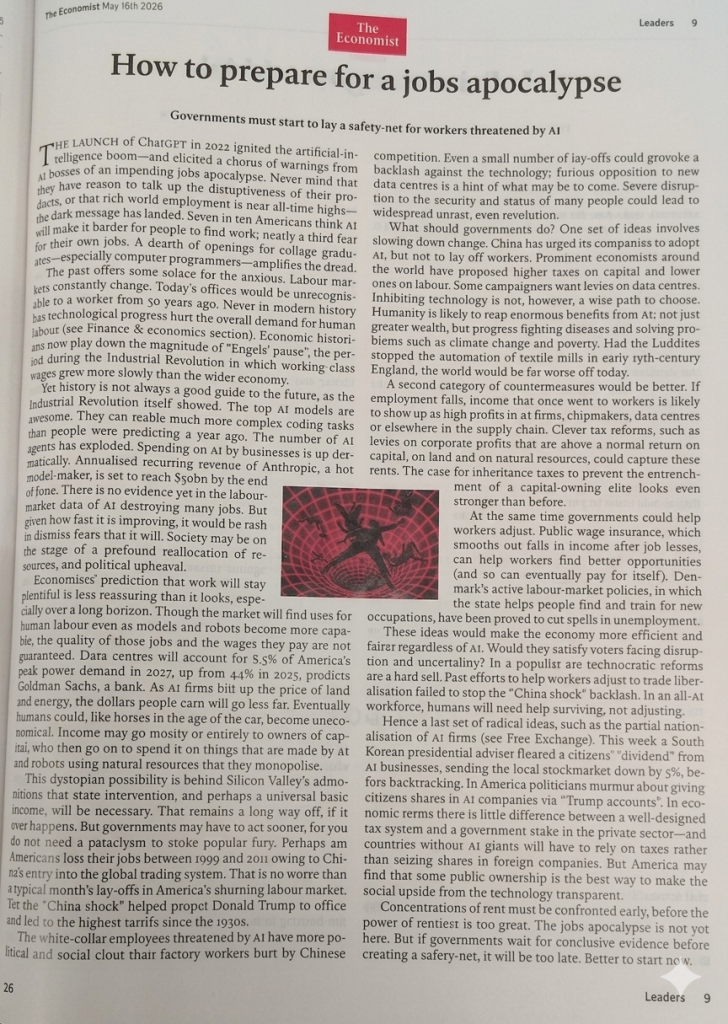
Based on the provided article from *The Economist* (dated May 16th, 2026), here is a detailed summary of the content and its core conclusion regarding how governments should handle the potential “jobs apocalypse” triggered by AI.## Executive SummaryThe article addresses the growing anxiety surrounding artificial intelligence displacing human workers. While historical precedents like the Industrial Revolution suggest that technology ultimately shifts labor markets rather than permanently destroying them, the rapid, unprecedented capabilities of AI present a unique threat. The text argues that governments must act proactively rather than waiting for catastrophic job losses to materialize, proposing a mix of tax reforms, robust safety nets, and radical state interventions.## Key Themes and Content Breakdown### 1. The Threat: Why This Time Might Be Different * **Public Anxiety:** Surveys indicate that seven in ten Americans believe AI will make finding work harder, with nearly a third fearing for their own positions. * **Unprecedented Capabilities:** Unlike past technological shifts, top AI models are rapidly mastering complex coding tasks much faster than anticipated. The explosion of AI agents and corporate spending (e.g., Anthropic’s projected $50bn ARR) highlights an aggressive corporate shift. * **The “Horse” Analogy:** While past innovations changed the *type* of human work, AI threatens to make human labor broadly uneconomical, drawing a parallel to how horses were entirely replaced by cars. Profits are likely to shift away from human labor and concentrate into AI infrastructure—land, energy (data centers), and capital.### 2. Proposed Government Responses and CountermeasuresThe article categorizes government interventions into three main approaches, weighing their pros and cons:| Strategy Category | Specific Measures | The Article’s Evaluation || :— | :— | :— || **Slowing Down Change** | * Taxing data centers. <br> * Urging companies to adopt AI but avoid layoffs (e.g., approaches seen in China). | **Weak:** Inhibiting technology is unwise; humanity stands to reap massive rewards from AI in medicine, climate change, and poverty alleviation. || **Tax Reforms & Reallocation** | * Clever corporate tax reforms. <br> * Levying taxes on windfall profits from data centers, land, and natural resources. <br> * Higher inheritance taxes. | **Better:** Captures the “rents” concentrated in the hands of a capital-owning elite and redistributes them. || **Safety Nets & Labor Support** | * Public wage insurance to smooth income drops. <br> * Denmark-style active labor-market policies (retraining and job matching). | **Necessary but Difficult:** While proven to work, technocratic reforms are a hard sell. Past failures to shield workers from the “China shock” proved that inadequate adjustments lead to severe political populist backlashes. || **Radical State Interventions** | * Partial nationalization of AI firms. <br> * Giving citizens direct shares/dividends in AI companies (e.g., South Korea’s “citizens’ dividend” proposal or “Trump accounts”). | **Valid Alternative:** Structurally, there is little economic difference between a well-designed tax system and a government stake in the private sector. It makes the upside of AI transparent to the public. |## ConclusionThe article concludes that **the “jobs apocalypse” is not yet here, but waiting for definitive proof of its arrival before building a safety net will be a catastrophic mistake.** Because the white-collar workers currently threatened by AI hold significantly more political and social influence than the factory workers displaced by past economic shifts, failure to act will spark severe political unrest, populism, and even revolution.> **The Core Takeaway:** Concentrated corporate gains from AI must be confronted early through tax and ownership reforms. Governments cannot simply wait and adjust later; they must start laying down aggressive economic safety nets **now**.>