
summerize ,and further topic of copy cat of China road map
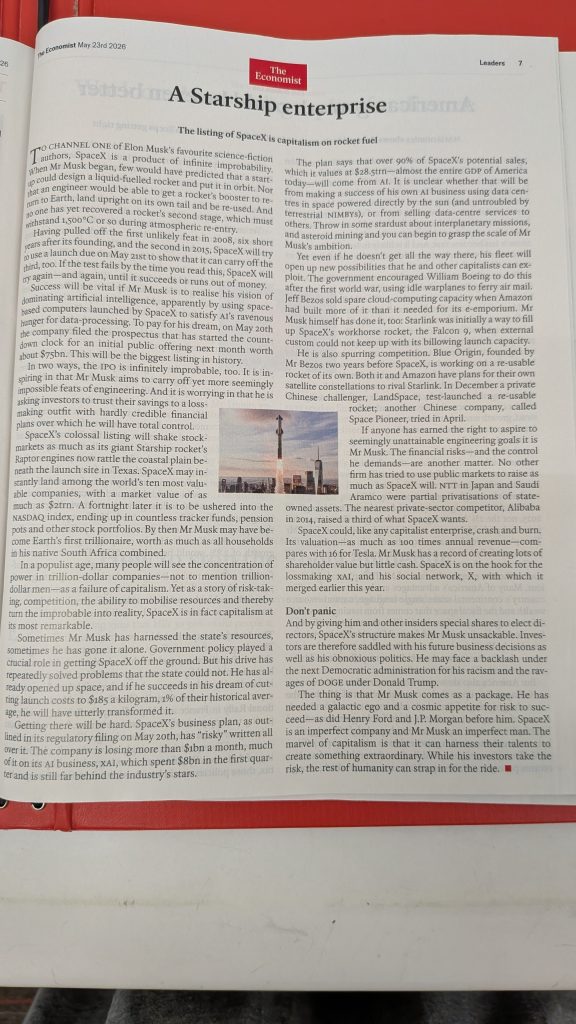
The article argues that SpaceX’s stock market listing shows how Elon Musk has turned a heavily state‑supported space company into a dominant, quasi‑monopolistic private enterprise, raising both admiration for its innovation and concern over its power and governance. It praises the engineering and cost breakthroughs, but warns that dependence on one politically erratic billionaire for critical space infrastructure is risky.
Brief summary of the article
- SpaceX has slashed launch costs with reusable rockets and now captures most of the global commercial launch market, while also running the fast‑growing Starlink satellite‑internet network.
- Its IPO (through a Starlink spin‑off) is framed as “capitalism on rocket fuel”: a mix of huge private profit and massive public support via NASA, Pentagon contracts, and regulatory help.
- The piece stresses that Musk’s success relied on state funding, patient contracts, and tolerance for “crash and burn” testing, making it misleading to view SpaceX as purely a heroic private triumph.
- Investors are excited by Starlink’s potential monopoly‑style cash flows, but the article notes governance risks: Musk’s control, his volatility, and the strategic importance of Starlink for Ukraine and Western militaries.
- It concludes that governments enabled SpaceX to rise and must now think carefully about how to regulate and constrain such a critical, privately controlled space utility.
(If you like, I can rewrite this in 2–3 bullet points only.)
“Copy‑cat China roadmap” angle – how China may imitate this model
Your “copy cat of China road map” question fits a real pattern: Beijing is already trying to build SpaceX‑style ecosystems combining state direction, commercial firms, and military use. Here are key themes you can develop:
1. State‑backed “private” launch firms
- China has encouraged dozens of nominally private launch startups (e.g., LandSpace, iSpace, Galactic Energy, Orienspace), but they sit within a state‑guided industrial policy with funding from local governments and state‑owned enterprises.
- The roadmap resembles SpaceX’s path: reusable rockets, methane engines, and vertical integration from launch to satellite constellations, but under stricter political control.
2. Chinese Starlink equivalents
- Multiple Chinese constellations have been announced (e.g., Guowang “national network,” Hongyun, Hongyan, and provincial projects) explicitly positioned as responses to Starlink’s dominance.
- Strategic goals are similar to Starlink: global broadband, resilient communications for the PLA, and a platform for data, cloud, and IoT services.
3. Dual‑use military logic
- Just as Western militaries now rely on Starlink for battlefield comms and resilient links, the PLA sees large constellations and cheap launches as a way to ensure secure communications and targeting data in a conflict.
- A Chinese roadmap would thus fuse civilian internet, Belt‑and‑Road connectivity, and military command‑and‑control into one integrated LEO constellation strategy.
4. Industrial policy and “whole‑of‑nation” push
- Where the article highlights NASA and Pentagon contracts as implicit subsidies for SpaceX, China would likely go further with direct subsidies, land grants, state bank loans, guaranteed launch orders, and government‑mandated demand from telecom and cloud giants.
- This could accelerate copy‑cat development but may dampen the kind of aggressive cost discipline and iterative risk‑taking that came from SpaceX facing market pressure.
5. Governance and geopolitical risk
- The article worries about Western dependence on a single private actor (Musk). In a Chinese roadmap, the dependency would be reversed: tightly state‑controlled “private” champions that foreign actors will hesitate to rely on because of security concerns.
- Result: a fragmented space‑internet world, with Starlink‑aligned networks versus Chinese constellations, similar to how global tech is bifurcating around US and Chinese standards.
Topics you can further explore or debate
If you want to extend this article into a discussion or essay on China’s “copy‑cat” roadmap, these are strong angles:
- “SpaceX with Chinese characteristics”: how a one‑party state changes the incentives and risks of the same techno‑financial model.
- Techno‑military race: Starlink vs Guowang as the new US–China competition layer, analogous to 5G and semiconductors.
- Capital markets: SpaceX listing in America vs how and whether China can use STAR Market / Hong Kong / special vehicles to fund its own champions while managing security secrecy.
- Governance contrast: Western fear of an unpredictable billionaire vs global fear of party‑controlled infrastructure; both raise different but serious systemic risks.
- Investment thesis: to what extent Chinese launch/constellation firms can replicate SpaceX‑level economics, given different institutional constraints and IP regimes.