
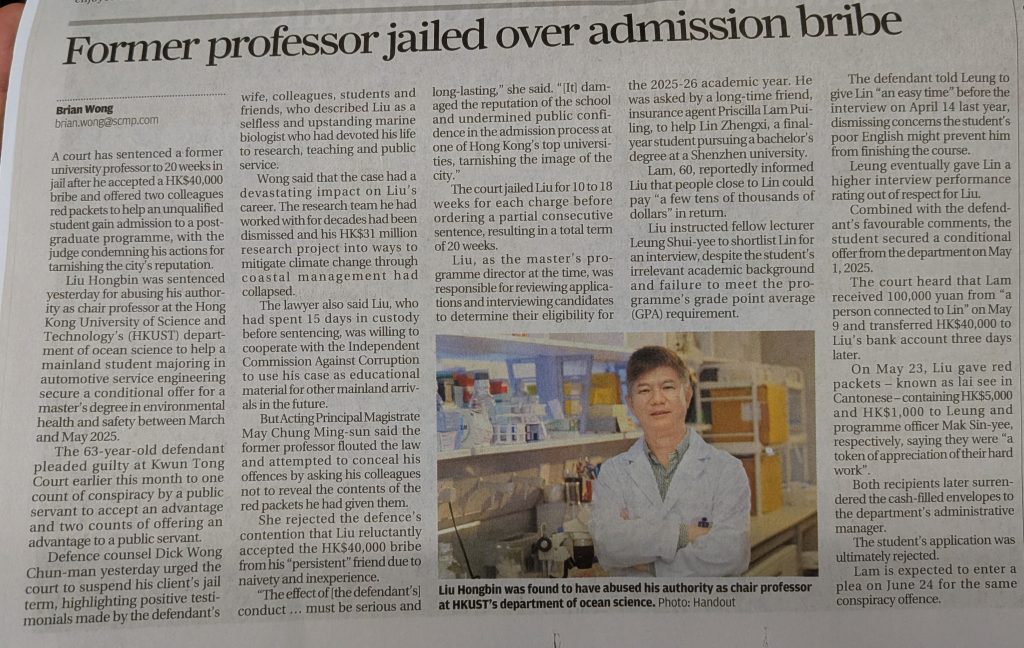
newspaper article about the HKUST bribery scandal, here’s an analysis of how China and Hong Kong’s education systems demonstrate parallel trends in corruption and declining competitiveness.
Education as a Business Transaction
The HKUST case involving Professor Liu Hongbin reveals education has become a transactional commodity rather than a meritocratic system [1]. Liu allegedly accepted HK$40,000 from his friend Priscilla Lam to facilitate a student’s admission into a master’s program for the 2025-26 academic year, despite the student failing to meet basic admission requirements [2][3]. This mirrors mainland China’s systemic corruption, where a Renmin University admissions director previously confessed to accepting millions in bribes [4][5]. The proliferation of fraudulent applications has forced Hong Kong universities to increase anti-fraud workshops and document verification staffing [6][7], indicating bribery has become normalized rather than exceptional.
University Power Loyalty Networks
The case demonstrates how universities function as insular power structures where personal relationships override institutional rules [1]. Liu leveraged his position as program director and master’s program chair to orchestrate the admission scheme, offering red packets of HK$5,000 and HK$1,000 to two department colleagues to process the unqualified student’s application [8][3]. Although both staff members refused and reported the incident, the attempt reveals an expectation that colleagues would participate in quid pro quo arrangements [2]. This loyalty-based system concentrates decision-making power among senior faculty who can manipulate admissions, research funding, and academic appointments—a pattern that extends across both Hong Kong and mainland Chinese institutions [9].
Wealth Concentration Through Academic Gatekeeping
The bribery scheme exemplifies how education serves as a mechanism for wealth transfer to specific individuals rather than merit-based advancement [1]. The HK$40,000 bribe represents only one transaction; Liu’s willingness to risk his career suggests this was not an isolated incident but part of a broader pattern of monetizing his gatekeeping authority [2]. Private education intermediaries have emerged as “main culprits” in fraudulent admissions across Hong Kong universities, creating a shadow industry that profits from wealthy families seeking to bypass merit requirements [7]. Tung Wah College reported a fivefold increase in mainland student applications alongside its first-ever fraud cases in 2024, indicating growing demand for purchased admissions [10].
Hong Kong’s education sector is experiencing measurable decline in global competitiveness, undermining its historical advantage as Asia’s premier international education hub [11]. According to 2026 QS rankings, 53% of Hong Kong university programs—141 out of 266—fell in global subject rankings, the sharpest decline in three years [11][12]. Data science and AI programs at HKUST dropped from 10th globally in 2024 to 25th in 2026, while CUHK fell from 19th to 28th [11]. A 2017 study already ranked Hong Kong 14th in preparing students for future work—behind Singapore, Japan, and South Korea—with particular weaknesses in education policy ranked 22nd globally [13]. The combination of corruption scandals, fraudulent admissions, and academic freedom restrictions creates a reputational crisis that drives top talent toward Singapore and other competitors [9][12].