

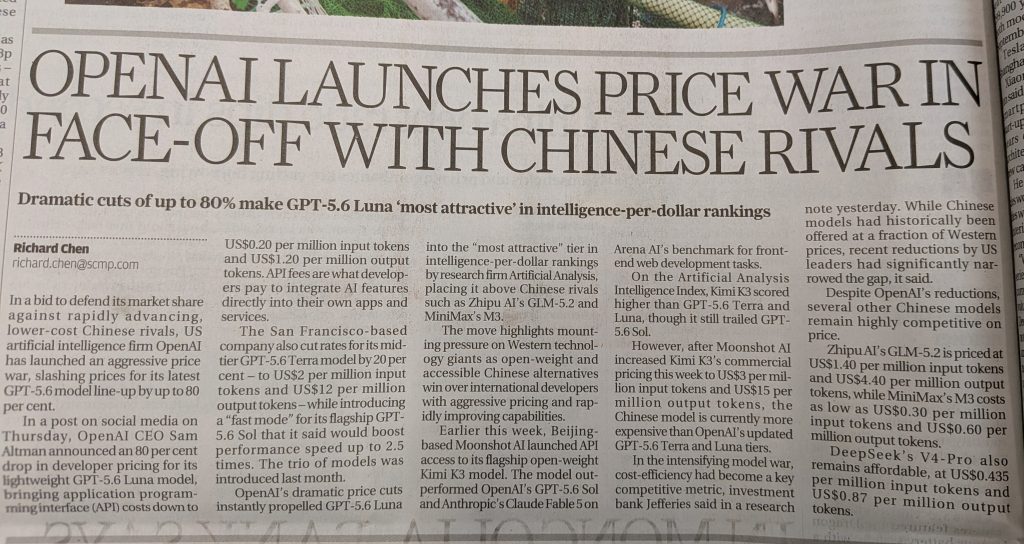
Source #SCMP
China’s AI service providers operate under a distinctly dual‑track strategy, separating domestic and international access points through differences in pricing, content governance, information boundaries, and functional positioning. These differences reveal not only technological choices but also China’s broader policy logic in digital governance, information security, and global AI competition.
1. Pricing and Content Governance: Low‑Cost Access Paired with High‑Intensity Control
Domestic AI access is priced extremely low—RMB 10 can purchase roughly 100,000 tokens—reflecting a policy preference for widespread AI adoption. However, this affordability is paired with strict content governance. Model outputs align closely with official narratives, and politically sensitive queries trigger a structured warning system: up to three warnings before the user account is suspended.
International access points maintain low pricing but use USD billing (e.g., USD 20 for 100,000 tokens). The political content restrictions remain, but enforcement differs: instead of warnings, accounts are directly terminated upon violation. This demonstrates a consistent political red line across markets, with enforcement calibrated to the expectations and risk profiles of each environment.
2. AI Search Boundaries: Policy‑Defined Information Sovereignty
Domestic access cannot penetrate the Great Firewall (GFW) to retrieve foreign information, resulting in a tightly bounded information ecosystem. International access similarly cannot penetrate the GFW to retrieve Chinese domestic content. This creates a two‑way information boundary:
- Domestic information does not flow outward.
- Foreign information does not flow inward.
This design reflects China’s “information sovereignty” approach—ensuring that AI systems do not inadvertently expose sensitive domestic data or disrupt the controlled information environment within China.
3. Critical Thinking Constraints: One‑Directional Political Expression
Domestic AI systems cannot criticize the Chinese government or political system, and sensitive topics are handled through avoidance or official framing. International versions follow the same rule: criticism of China is prohibited. However, they are allowed to criticize foreign governments or international political actors.
This creates a one‑directional political expression model:
- Internal criticism prohibited.
- External criticism permitted.
The policy objective is clear: maintain domestic political stability and protect China’s international narrative, while still offering enough critical capability to meet global user expectations.
4. Functional Positioning: National Narrative vs. Global Competitiveness
Domestic AI access emphasizes national pride, cultural confidence, and the value of abundant low‑cost labor. AI is framed as a supportive tool rather than a transformative productivity engine. International access, by contrast, highlights intelligence, efficiency, and productivity—aligning with global AI competition and commercial expectations.
This dual positioning reflects China’s two policy roles for AI:
- Domestic role: reinforce national narratives, maintain social stability, and avoid disruptive productivity shifts.
- International role: demonstrate technological capability, enhance competitiveness, and participate in global markets.
Conclusion
China’s AI service providers implement a clear dual‑track strategy shaped by policy priorities. Domestic versions emphasize low cost, strict governance, controlled information flow, and narrative consistency. International versions maintain political boundaries but focus on productivity, competitiveness, and global market integration. Together, these approaches illustrate China’s broader governance logic in the AI era—balancing internal stability with external ambition.