

Dual Layers in China’s Economy: Export Rebates, Thin Margins, and a Deepening Crisis Loop
China’s economic structure has developed dual layers that reflect deliberate policy choices by the central government. These layers separate firms that survive on thin commercial profits supplemented by state support from those that struggle without it, while simultaneously straining local finances and distorting global competition. The result is a self-reinforcing crisis that undermines the long-term viability of Chinese manufacturing.
At the firm level, many exporters operate with razor-thin margins. Production costs, intense domestic competition, and pressure to keep prices low leave little room for genuine profitability. The decisive cushion comes from the export tax rebate system. By refunding value-added tax on exported goods, the government effectively transfers substantial fiscal resources to exporters. For many companies, the rebate becomes a larger source of net income than operating profit itself. This creates a dual reality: on paper the firm remains competitive and continues to export; in commercial terms it is only marginally viable or even loss-making without the subsidy.
The second layer appears in labour practices. Because the rebate is calculated on export value rather than employment, firms have strong incentives to protect margins by reducing headcount. Smaller manufacturers in particular shed workers, automate selectively, or shift to lower-labour-intensity processes. The policy therefore simultaneously props up export volumes while encouraging the contraction of labour absorption—the very mechanism that once allowed China to move hundreds of millions of people out of agriculture. Productivity gains in advanced sectors coexist with job losses in the broader manufacturing base, reinforcing the dual structure.
These firm-level dynamics collide with fiscal reality at the provincial level. Many local governments face structural deficits. Land-sale revenues have declined, debt burdens remain high, and social-spending obligations continue to grow. Export rebates themselves are ultimately financed through the fiscal system, so the same policy that keeps exporters afloat adds to local budgetary pressure. The central government, constrained by its own weak net fiscal position and competing priorities, has been reluctant to provide progressive, large-scale transfers that would fully offset provincial shortfalls. The result is a second dualism: coastal and export-oriented localities that still generate activity versus inland or heavily indebted provinces that struggle to maintain basic services and investment.
Internationally, the rebate system produces a further distortion. Subsidised Chinese exports lower prices in global markets, placing pressure on manufacturers in other countries. Yet the advantage is not costless for China. Because the rebate sustains industries that would otherwise be unprofitable, it locks capital and labour into low-margin activities. Overseas competitors respond by relocating, seeking alternative suppliers, or demanding protective measures. Chinese firms, still dependent on the rebate, cannot easily raise prices or shift to higher-value products without losing volume. The outcome is a crisis loop: continued reliance on export subsidies maintains short-term employment and foreign-exchange earnings while eroding genuine profitability, intensifying domestic labour shedding, and inviting external pushback that further squeezes margins.
In this configuration, dual layers are not accidental. They are the product of a policy that prioritises export scale over commercial sustainability, transfers fiscal resources to firms while under-supporting local governments, and externalises competitive pressure without securing durable gains for Chinese industry. Breaking the loop would require reducing dependence on rebates, allowing uncompetitive capacity to exit, and aligning fiscal support with genuine productivity and employment goals rather than volume alone. Until that adjustment occurs, the dual structure will continue to generate thin profits, fewer jobs, strained provincial budgets, and a manufacturing sector that remains vulnerable both at home and abroad.
The Article Summary
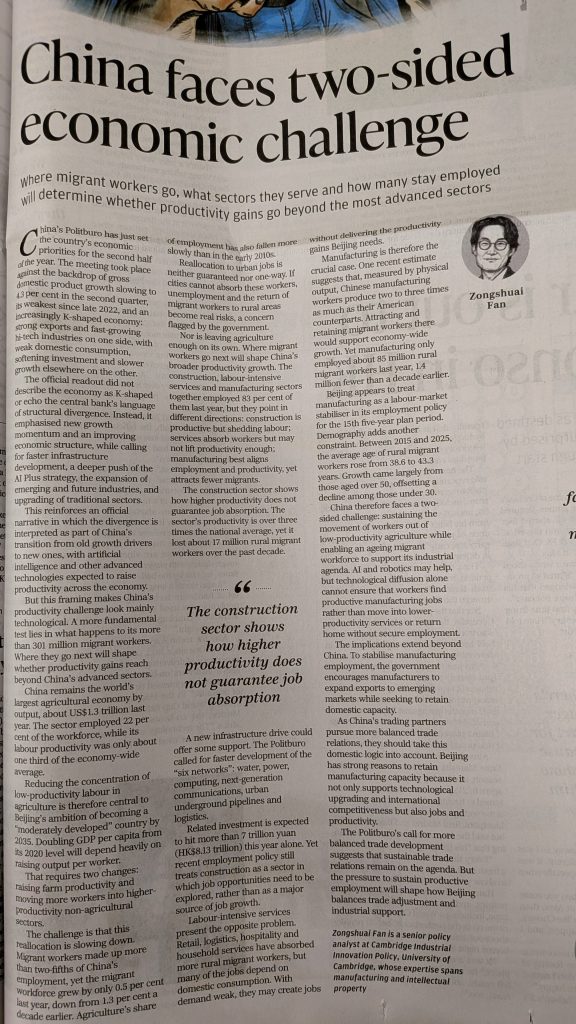
China’s Politburo has set economic priorities for the second half of the year amid slowing growth. Gross domestic product growth is decelerating, with strong exports (especially in high-tech sectors) contrasting with weak domestic consumption and soft investment. Officials describe a “K-shaped” recovery: advanced and high-tech industries are rising while traditional and labour-intensive sectors lag.
The central challenge is structural. China aims to raise productivity through AI, advanced technologies, and upgrading of traditional industries, while shifting the economy toward higher-value activities. However, this risks leaving behind the large migrant workforce that has powered growth. Manufacturing remains critical—Chinese manufacturing output is still far larger than that of the United States and continues to employ tens of millions of migrant workers—but higher productivity does not automatically create enough new jobs.
The construction sector has historically absorbed large numbers of rural migrant workers, yet it does not guarantee sustained high-productivity employment. Relocation of workers from cities back to rural areas or rising unemployment would undermine the productivity gains China needs. Demographic pressures (an ageing and shrinking rural migrant workforce) add urgency.
Policy recommendations emphasise retaining manufacturing capacity, supporting technological upgrading and international competitiveness, pursuing more balanced trade relations, and ensuring that infrastructure and industrial strategies create genuine job opportunities rather than simply absorbing labour temporarily. Labour-intensive services and continued absorption of migrant workers into higher-productivity sectors are also highlighted as necessary.
The author, Zongshuai Fan (senior policy analyst at Cambridge Industrial Innovation Policy, University of Cambridge), frames the core dilemma as two-sided: China must deliver productivity gains beyond the most advanced sectors while keeping large numbers of migrant workers productively employed.
Conclusion
China faces a dual economic challenge of raising overall productivity through technological upgrading and high-tech development while simultaneously ensuring that the large migrant labour force remains absorbed in productive employment rather than returning to low-productivity agriculture or falling into unemployment. Success depends on carefully managing the transition so that manufacturing retains capacity, construction and infrastructure projects generate real opportunities, and policy supports both advanced sectors and broader job creation. Without this balance, the shift toward higher-value growth risks becoming uneven and socially costly.