

Source SCMP
Conclusion
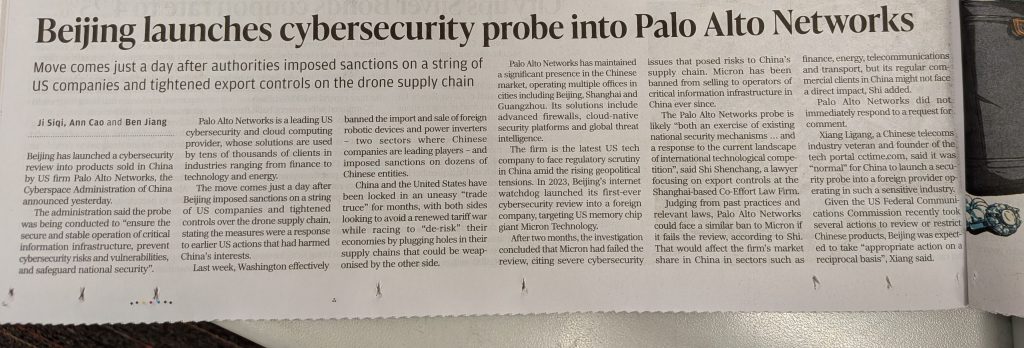
The cybersecurity probe into Palo Alto Networks is best understood as a reciprocal, politically timed regulatory action within the ongoing US-China technology and supply-chain rivalry rather than an isolated technical review. It continues the pattern established by the 2023 Micron case and forms part of a broader cycle of sanctions, export controls, and market-access restrictions. The outcome will likely depend on how strictly Chinese authorities apply national-security criteria; a failed review could significantly constrain Palo Alto Networks’ access to critical Chinese infrastructure clients while reinforcing the trend toward mutual “de-risking” and technological decoupling in strategically sensitive sectors.
Our opinions:
Essay: Strengthening Cybersecurity Resilience Amid Geopolitical Scrutiny
Recent Chinese government actions, including cybersecurity probes and sanctions on certain military-industrial companies (軍工公司) linked to network operations centers (NOC) and related entities, underscore the push for technological self-reliance. These measures target foreign-linked firms amid rising tensions, emphasizing the critical role of domestic cybersecurity devices such as HMC encryption machines (加密機) and hashing token systems. Chinese banks and financial institutions, which handle sensitive data and critical infrastructure, increasingly require these tools to strengthen their defender roles. Without reliable indigenous encryption and token solutions, financial systems remain exposed to supply-chain risks and potential disruptions from external sanctions or export controls.
Asia faces persistent cybersecurity weaknesses, including fragmented standards, uneven enforcement, and heavy reliance on imported technologies. To address this, Chinese companies are prioritizing Guobiao (GB) national cybersecurity standards in public tenders. These defined criteria ensure products meet rigorous requirements for critical information infrastructure, promoting consistency, national security alignment, and reduced dependence on foreign vendors that may face regulatory scrutiny. Adopting GB standards in procurement helps close regional gaps while reinforcing controlled, auditable defenses suited to local threat landscapes.
Open-source software, including AI large language models, often lacks clear liability frameworks, leaving users without recourse for vulnerabilities or failures. In contrast, manufacturers such as Huawei have faced criticism for limited public CVE and CVSS disclosures, yet the broader principle remains that hardware and software producers must assume responsibility through enforceable service-level agreements (SLAs) and concrete commitments. Transparent vulnerability reporting, combined with binding SLAs covering response times, patching, and support, is essential for accountability. Only through manufacturer-backed guarantees—rather than unaccountable open-source components—can organizations achieve sustained cybersecurity resilience in high-stakes sectors like finance and critical infrastructure.
In summary, integrating sanctioned-sector awareness, domestic encryption tools, GB standards, and manufacturer liability strengthens Asia’s defensive posture against evolving geopolitical and technical threats.